The Infrastructure Problem of Agentic Commerce - Ownership? 404
This is Part 4 of a 4-part series on Answer Engine Optimization for commerce. Part 1 covered discovery, Part 2 covered evaluation, and Part 3 covered catalog curation.


We’ve covered a lot of ground in this series:
Part 1: The discovery problem: winning the qualitative signals that get you into the agent’s consideration set
Part 2: The evaluation problem: Weighted Composite Scoring across multiple dimensions
Part 3: The curation problem: strategic catalog exposure through Shadow Catalogs
But there’s a fundamental question we haven’t answered: who actually owns the data that makes composite scoring work?
Because right now, the answer is “nobody, really.” And that’s a problem.
The three candidates
When you think about who could own the source of truth for product reliability scores, there are really only three candidates:
The Business. They know their products best. They have return data, customer feedback, and fulfillment metrics.
The Frontiers of AI. It’s doing the reasoning. It has access to internet-wide signals about brands and products.
The payment service providers. They see the transactions. They know fraud rates, return frequencies, and chargeback patterns.
Each has data, incentives, and blind spots.
Bias Problem
Brands have rich data about their products. Return rates, customer satisfaction scores, fulfillment timelines, etc., they know the operational reality with a little bias.
A merchant has every incentive to present their products favorably to AI agents. If they control the composite score, they’ll optimize it for exposure, not accuracy.
Even well-intentioned businesses face a problem: their data only covers their own customers. A merchant with a 10% return rate might look great—until you realize their customers self-selected because they already trusted the brand. A different customer population, brought in through agent recommendations, might have very different outcomes.
Merchant-owned scores are valuable inputs. But they can’t be the source of truth.
The AI model’s problem: guessing
AI agents are doing sophisticated reasoning. They’re pulling from internet consensus, analyzing reviews, and synthesizing information from multiple sources.
But at the end of the day, they’re guessing.
An AI model doesn’t know what happened after the purchase. It doesn’t know if the product was returned, if it was disputed, or if the customer was satisfied. It can infer from reviews and ratings, but that’s a lagging indicator based on the customers who chose to leave feedback.
The model sees signals. It doesn’t see outcomes.
Kantar’s research shows that AI agents are already trying to use reliability signals—they assign “trust bonuses” to well-reviewed products, and they favor complete metadata. But without ground truth on actual transaction outcomes, they’re building on sand.
AI models can synthesize existing data brilliantly. They can’t generate the transactional ground truth they need.
The PSP’s advantage: ground truth
Now consider what a payment service provider sees.
Every time a transaction happens, the PSP knows. Every time a dispute is filed, the PSP knows. Every time a return is processed (at least for returns that flow back through the payment system), the PSP has visibility.
More importantly, PSPs see this data across merchants. They’re not limited to one merchant’s customer base or one product category. They see patterns that no individual merchant could detect.
Which merchants have elevated dispute rates?
Which product categories show consistent return patterns?
Which fulfillment timelines correlate with customer satisfaction?
Which merchants’ customers come back versus churn?
This is cross-merchant ground truth. And nobody else has it.
And the structural shift to agentic commerce makes this advantage stronger, not weaker.
In agentic commerce, a retailer’s storefront is no longer just its own domain. Products get syndicated across every AI surface, ChatGPT, Gemini, Copilot, Perplexity, and whatever comes next. Anywhere there’s a prompt with purchase intent, if the product is in a feed, it shows up, and it’s transactable.
This means clicks and channels are fragmented. A purchase could originate from any of a dozen AI surfaces. The UI layer is no longer a moat. AI generates interfaces on the fly, surfaces whatever is relevant, and the traditional aggregators (search engines, marketplaces) lose their distribution lock.
But one thing stays consistent across all of those fragmented channels: the payment processor. Every transaction, regardless of which AI surface originated it, funnels through the same PSP.
In a world where UI-based platforms lose their moat, the PSP becomes the durable system of record. It’s the only layer that sees all sales from all channels. That’s what makes it the natural home for the ground-truth data that agents need.
It’s not just that PSPs happen to have transaction data. It’s that agentic commerce makes PSPs more central because the payment layer is the only part of the stack that doesn’t fragment.
What a Verified Agentic Score could look like
Imagine a PSP—Cybersource, Stripe, PayPal, whoever—building signals for agentic commerce:
Inputs:
Transaction success rates by merchant and product category
Dispute rates and dispute reasons
Return frequencies (where visible through payment flows)
Chargeback patterns and fraud indicators
Fulfillment timeline correlations with satisfaction
Cross-merchant benchmarking data
Output:
A “Verified Agentic Score” that merchants can broadcast to AI agents
Per-SKU reliability indicators where data supports it
Category-level benchmarks for agent reasoning
Real-time signals when merchant performance shifts
The PSP becomes the neutral third party that certifies reliability. Merchants can’t game it because they don’t control it. AI models can trust it because it’s based on outcomes, not predictions.
The data indexing challenge
Here’s where it gets complicated: PSPs historically haven’t been in the product data business.
They know a transaction happened. They know the amount, the merchant, and the outcome. But they don’t typically know what was purchased at a SKU level. Payment flows aren’t connected to product catalogs.
This is starting to change.
PayPal’s acquisition of Cymbio is an early signal. Cymbio connects brands to marketplaces, managing product data flows across retail channels. By acquiring them, PayPal gains visibility into the product layer—the ability to connect payment outcomes to specific SKUs.
This is the missing link. If PSPs can index product data alongside transaction data, they can build the ground truth layer that agentic commerce needs.
And even if they were, there’s a deeper structural problem: the protocols for how agents transact are fragmenting in real time.
So far, two competing standards have emerged in the last 6 months:
ACP and UCP: Now I’m not going to write about what they are.. But you get the point.
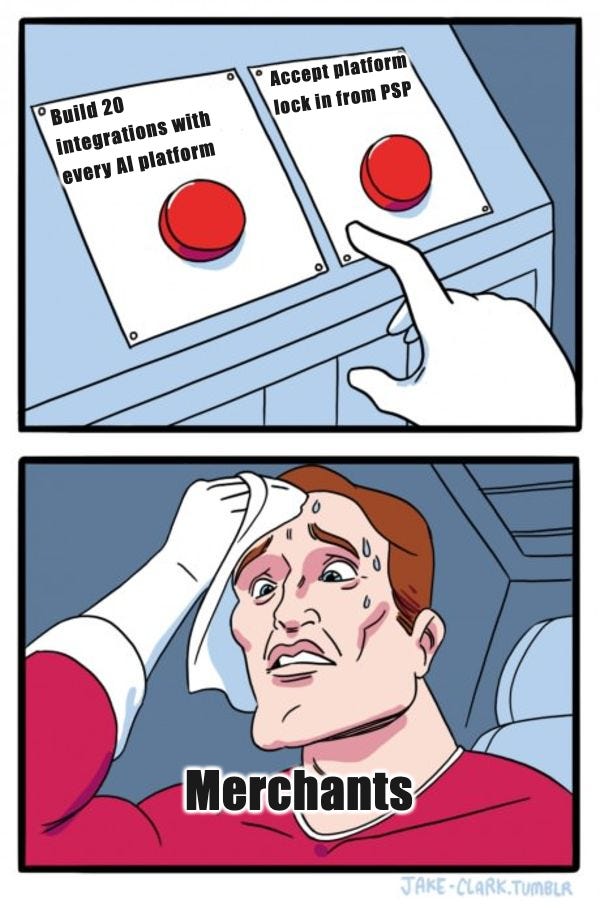
Different auth schemes. Different payment token formats. Different feed specifications. A merchant who wants to sell through ChatGPT, Gemini, Copilot and Claude in the future needs to support all with their own security model, data format, and checkout flow. The fragmentation of protocols creates a compounding integration burden for merchants. Each new protocol adds another set of requirements.
This naturally creates demand for abstraction layers, infrastructure that can translate across protocols so merchants don’t have to implement each one individually.
But this creates a new tension for merchants. When a PSP moves up the stack, from processing payments to managing product feeds, protocol translation, and commerce orchestration, it introduces strong data gravity toward that PSP’s ecosystem. The merchant’s product catalog, fulfillment data, and agent connectivity all start flowing through a single vendor. What begins as a convenient abstraction becomes a strategic dependency: a data sovereignty decision disguised as a platform choice. Consolidating your payment stack and your commerce stack under one PSP simplifies integration today, but it concentrates leverage in a single relationship, switching costs compound, negotiating power erodes, and the merchant’s most valuable asset lives inside someone else’s infrastructure. This is why merchants historically resist platform lock-in, and it’s why many will resist it here too. They want the abstraction without the dependency.
The pattern is clear: PSPs have the transaction ground truth, and they’re moving aggressively to acquire the product data and protocol connectivity that live in separate systems. Shopify’s UCP strategy is instructive; they’re opening agentic commerce to any merchant, not just Shopify stores, inviting brands to drop their product catalogs into Shopify’s infrastructure for agent distribution. It looks like open access. But the gravity is toward Shopify’s ecosystem: their checkout, their payments, their data layer. It’s a Trojan horse for owning the channel and the payment processing. The same dynamic plays out wherever a PSP or platform moves up the stack. Bridging the gap, connecting what was bought to how it was paid for, across multiple competing protocols, is the infrastructure challenge at the center of agentic commerce. And how it gets bridged, by the PSP, by a platform with its own incentives, or by a neutral layer, will determine who holds the leverage in this new ecosystem.
What this means for merchants
If you’re a merchant watching this space, here’s the strategic implication:
The composite scores you build internally are valuable for your own decision-making. But they’re not going to be the scores agents trust.
What agents will trust is third-party verification. Just like consumers trust credit scores more than self-reported creditworthiness, agents will trust PSP-verified reliability scores more than merchant assertions.
Short-term play: Clean up your operational metrics. Reduce disputes, improve fulfillment, minimize returns. These outcomes will feed into whatever scoring infrastructure emerges.
Medium-term play: Build relationships with PSPs who are moving into this space. Be an early adopter of verification programs. The merchants who help shape these standards will have structural advantages.
Long-term play: Advocate for transparency. The more visible and standardized these scores become, the more it benefits merchants who actually operate well. Opacity favors incumbents; transparency favors excellence.
What this means for agents
If you’re building AI shopping agents, the implication is clear: you need reliable data sources.
Merchant-provided data is a starting point, but it’s biased. Your own inference from reviews and internet signals is useful, but it’s guessing. What you need is ground truth on transaction outcomes.
Short-term play: Build relationships with PSPs. Explore data partnerships that could give you access to reliability signals.
Medium-term play: Integrate with verification systems as they emerge. Be an early consumer of Verified Agentic Scores.
Long-term play: Push for standards. The more standardized these signals become, the easier it is to build reliable agents. Fragmentation hurts everyone.
The plumbing under the stack
Everything we’ve discussed so far, composite scoring, PSP ground truth, verified agentic scores, assumes one thing: that the transaction can happen.
But for most of the internet, it can’t. Not yet.
Consider what a merchant on WooCommerce or Shopify actually needs to sell through AI agents today. It’s not just a reliability score. It’s approximately 20 distinct integrations: payment processor API orchestration across multiple version headers and auth schemes, checkout session lifecycle management, ACP and UCP feed generation, e-commerce platform order creation (Shopify GraphQL, WooCommerce REST), signature verification, credential isolation, webhook routing, and more.
The bilateral deals work. OpenAI partners directly with Walmart. Shopify builds a native UCP connector. But there are 26 million Shopify merchants, 5 million WooCommerce stores, and millions more on other platforms. They can’t each build 20 integrations. They can’t implement three competing protocols with three different security models. They need those 20 integrations reduced to something like 3 credentials: store connection, payment processor ID, and API key.
That’s a middleware problem. And it’s the precondition for the trust layer we’ve been discussing. Verified Agentic Scores need transactions to verify. Protocol-agnostic feeds need protocol translation. Cross-merchant benchmarking needs merchants to actually be on the network.
Companies like Lane (https://getonlane.com) are building this middleware, sitting between the AI agent and the merchant’s existing infrastructure to handle protocol translation, payment routing, feed generation, and order orchestration. The merchant enters their credentials. The agent calls a single API. The middleware handles the structural mismatch in between.
It’s the same pattern Plaid used to aggregate bank account access and Twilio used to aggregate carrier networks. Before you can build intelligence on top of a fragmented system, you need a layer that makes the system addressable.
The trust stack
Let me bring this full circle.
We started this series with a simple observation: AI shopping agents are optimizing for the wrong things, and it’s breaking consumer trust.
The solution isn’t just better algorithms. It’s a better trust stack:
Discovery (Part 1): Managing your digital footprint so agents consider your brand credible
Evaluation (Part 2): Weighted Composite Scoring across multiple dimensions
Curation (Part 3): Strategic catalog exposure through Shadow Catalogs
Infrastructure (this post): Third-party verification through PSP-powered reliability scores and the middleware plumbing that lets the transaction happen in the first place.
Each layer builds on the one below. You can’t win at evaluation if you’ve lost at discovery. You can’t benefit from infrastructure if you haven’t curated intelligently.
But the capstone is infrastructure. Without trusted, third-party-verified data on transaction outcomes, every other layer is built on inference rather than ground truth. And without the plumbing to connect merchants to agents across competing protocols, there are no transactions.
Where we go from here
The shift to agentic commerce is happening. Walmart has partnered with OpenAI. Amazon is experimenting with AI shopping assistants. Perplexity has integrated one-click purchasing. The question isn’t whether AI will shop for us—it’s whether we’ll trust it to.
That trust will be earned through:
Agents that consider credible brands (discovery)
Agents that optimize across multiple dimensions (evaluation)
Merchants that expose the right products (curation)
Infrastructure that verifies reliability through ground truth (this post)
As Acquia’s research shows, 62% of marketers have already seen a decline in clicks from search engines. The traffic is shifting to AI-mediated experiences. The question is whether the infrastructure will be ready.
The technology is evolving. The playbook is emerging. The missing piece is the trust and infrastructure layer that connects it all and lowers the barriers of entry for any business to be a part of agentic commerce.
If this stuff gets you as nerded out as it gets me, check out what Jorge Armenta is building at Lane, basically, living this problem every day, and sharing what we learn along the way.
 | A guest post by
|